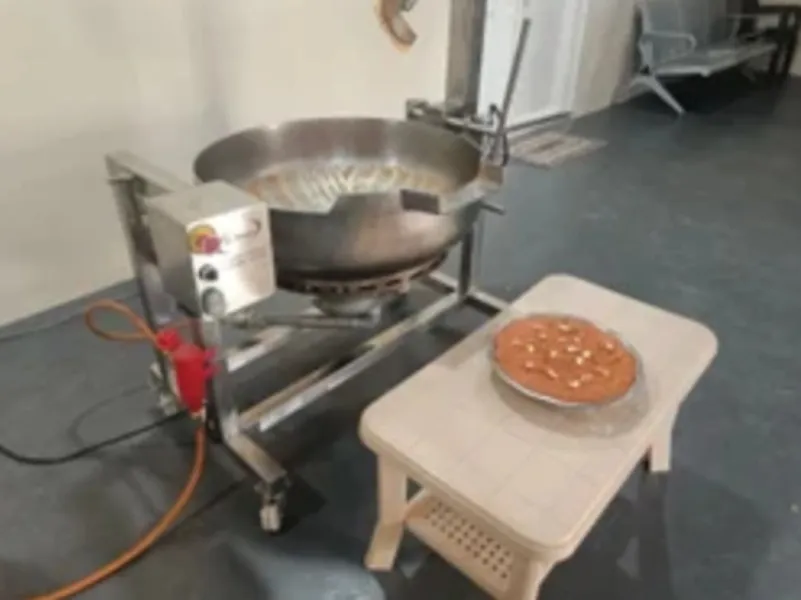
Traditional halwa preparation demands close attention. Heating, mixing and maintaining the desired consistency can require continuous involvement, especially when production moves from household quantities to commercial batches. An Automatic Halwa Making Machine can help businesses mechanise repetitive parts of this process.
For sweet manufacturers, caterers and commercial kitchens, the choice between manual and mechanised preparation depends mainly on production volume, labour requirements and consistency expectations.
Manual Preparation
Manual halwa making offers direct control over every stage. It can work well for small batches and businesses where production remains limited.
As volume increases, however, challenges can emerge. Continuous stirring becomes physically demanding, larger vessels become harder to handle, and results may vary when different employees manage preparation.
Manual processes can also occupy skilled kitchen staff who could otherwise manage ingredient preparation, quality checks or other products.
Mechanised Preparation
An automatic or mechanised system uses controlled mixing to reduce continuous manual stirring.
Potential operational advantages include:
- Reduced repetitive labour
- More consistent mixing
- Easier handling of larger batches
- Better use of staff time
- More predictable production workflow
The machine does not replace recipe knowledge. Ingredient ratios, temperature management, cooking duration and final quality checks remain important.
Which Option Makes Better Commercial Sense?
A business preparing occasional small batches may find traditional methods sufficient.
Mechanisation becomes more relevant when:
- Daily demand is increasing
- Multiple batches are prepared regularly
- Manual stirring requires substantial labour
- Batch consistency is difficult to maintain
- Production needs to scale
- Staff fatigue is affecting workflow
The financial decision should consider labour hours saved rather than equipment price alone.
Check the Machine Against Your Recipe
Halwa recipes differ in ingredients, viscosity and cooking behaviour. Buyers should therefore discuss the intended product with the manufacturer rather than assuming every machine configuration suits every preparation.
Capacity is particularly important. A machine designed for significantly larger batches than required may not be the most efficient choice.
Coimbatore has a long-established machinery manufacturing base supporting food businesses throughout Tamil Nadu. G Tech Engineering manufactures commercial food-processing equipment for businesses considering mechanised cooking and mixing processes.
Before purchasing, provide the manufacturer with typical batch size, ingredients, expected daily production and available power supply. Also ask about cleaning procedures and operating requirements.
For growing sweet shops and commercial kitchens, the objective of automation should be practical: reduce repetitive work while maintaining control over the recipe and final product. When machinery is properly matched to the production process, it can make scaling considerably easier.
Keywords