A juicer crushes cane and separates juice from bagasse; a peeler only removes the outer surface, so the two machines solve different problems. By comparing workflow, throughput, hygiene, electrical fit and labour, you can decide which equipment belongs in your shop and test its claims before purchase.
Key takeaways
- Choose a juicer when your core product is fresh sugarcane juice.
- Choose a peeler only when peeled cane supports your menu or prep process.
- Size the juicer for peak-hour demand, not average daily sales.
- Check food-contact materials, cleaning access, motor protection and power supply before buying.
What does each machine actually do in a juice-shop line?
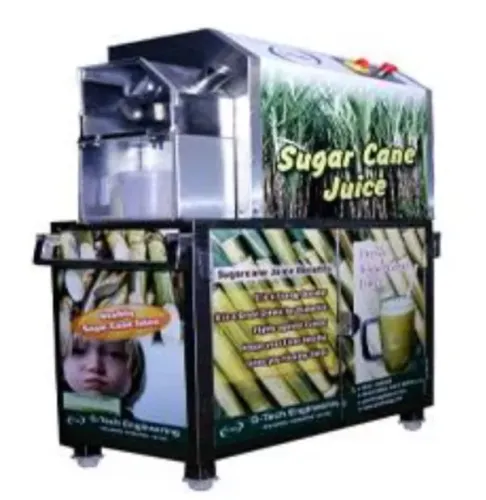
A sugarcane juicer feeds cane through two or three rollers, presses out saleable juice and discharges the fibrous bagasse. A sugarcane peeler removes the outer material only; it must be followed by a juicer or another extraction process. A peeler is therefore not an extractor.
| Machine | Job completed | Juice-shop consequence |
|---|---|---|
| Sugarcane juicer | Crushes or mills cane, separates juice from bagasse and sends juice to a tray or filter | One machine completes the saleable-juice step, with faster counter service and less operator movement |
| Sugarcane peeler | Removes the outer surface and creates peel waste | Requires extra counter space, handling and cleaning, then still needs a juicer or downstream process |
| Peeler plus juicer | Peels first, then extracts juice | Adds a process stage, operator movement and waste; speed falls if each cane is peeled before pressing |
The practical sugarcane juicer machine versus sugarcane peeler machine in Coimbatore decision depends on the job your line must finish, not motor horsepower or catalogue appearance. For ordinary fresh-juice service, buy the machine that extracts juice.
The sugarcane peeler machine comparison becomes relevant when you sell peeled cane portions, supply another processing line or need a specified surface-reduction step. Otherwise, peeling consumes space and labour without replacing the juicer.
Where does peeling fit between receiving cane and serving juice?
Commercial cane does not need peeling before pressing at a conventional fresh-juice counter. Washing, trimming damaged ends and cutting away visibly dirty sections usually cover the main preparation need without adding peel waste, handling and preparation time.
- Receive and inspect the cane; reject pieces with mould, rot or heavy contamination.
- Remove damaged ends and visibly dirty sections.
- Wash the usable cane with potable water, then keep it off floors and dirty work surfaces.
- Trim each piece to a length the juicer feed opening accepts reliably.
- Peel only when your product specification requires peeled cane, peeled portions or a defined surface-reduction step.
- Press the cane, then strain or filter the juice according to your serving method.
- Chill the juice or serve it promptly; do not leave ready-to-consume juice standing at ambient temperature.
- Remove bagasse from the discharge area and place it in a designated waste container.
Peeling can reduce surface dirt and waxy outer material, but it does not kill pathogens. It also consumes operator movement, creates peel waste and can slow feeding; a badly peeled piece may still jam or feed poorly. Flavour and extraction gains are not automatic, so test them rather than assuming them.
Keep the juice path—rollers, tray, strainer and container—clean, and prevent washed or peeled cane from touching dirty surfaces. A practical sugarcane peeler machine comparison therefore asks whether the specification justifies another step, not whether peeling sounds more hygienic.
How much output can a juicer deliver during Coimbatore rush hours?
A commercial cane juicer in Coimbatore must be judged by sustained counter throughput, not its fastest short run. Record both canes per hour and litres per hour: the Table Top TT-500 Mini has a published claim of up to 60 litres of juice per hour, while the figures below require written verification.
| Model | Published output position | What to verify |
|---|---|---|
| Table Top TT-500 Mini | Up to 60 litres/hour claimed | Canes/hour and sustained litres/hour |
| Bin-1000 | No comparable figure supplied | Canes/hour, litres/hour and duty cycle |
| Table Top Mini | No comparable figure supplied | Canes/hour, litres/hour and duty cycle |
| Stand with Bin | No comparable figure supplied | Canes/hour, litres/hour and duty cycle |
Run one cane batch through the machine and record kilograms processed, litres extracted, wet bagasse, residual juice in bagasse, stoppages, jam-recovery time, motor-temperature rise, restart behaviour, operator count and cleaning minutes. Note cane diameter, length, fibre content, loading time, operator speed, roller-gap setting, and pauses for rinsing or dismantling.
A roller setting that increases extraction can slow feeding or raise motor load.
A machine that reaches its peak rate for ten minutes can serve fewer cups across a two-hour rush after loading delays, jams, cooling, and cleaning. This is the practical sugarcane juicer machine versus sugarcane peeler machine in Coimbatore test: compare saleable juice and completed orders, not catalogue speed alone.
A peeler still needs a downstream extractor, so include its handling time and peel waste in the counter calculation.
Which machine specifications protect hygiene, reliability and installation?
For juice shop equipment in Coimbatore, compare each machine with the cane you actually receive and the circuit you can safely install. A compact machine that stalls on thick, fibrous cane will lose more service time than a larger machine with a slower peak rate.
| Specification | What to check | Why it matters |
|---|---|---|
| Feed and rollers | Opening, roller diameter, material, speed and adjustable gap | Tight gaps raise load and wear; wide gaps leave juice in bagasse |
| Extraction layout | Two- or three-roller arrangement, juice tray and bagasse discharge | Separates juice cleanly and prevents waste from blocking the outlet |
| Construction | Smooth, corrosion-resistant food-contact surfaces with accessible joints | Stainless steel alone does not prevent residue traps |
| Drive protection | Overload protection and continuous-duty rating | Tests whether the machine survives rush-hour cycling, jams and restarts |
Inspect roller ends, bearings, welded joints, seals and juice trays by sight and touch. Residue trapped in these areas defeats a smooth outer finish. Keep lubricants, bearings and gearboxes outside the juice splash zone, and confirm that seals can be replaced without major disassembly.
Ask the supplier to state in writing:
- Single-phase or three-phase supply, voltage, connected load and starting current
- Earthing, overload protection, plug or isolator, dedicated circuit and stabiliser requirements
- Motor-temperature rise, restart behaviour after overload and cleaning time
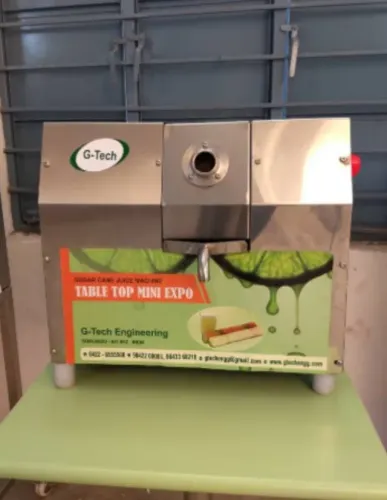
The Table Top Mini is listed with a 0.5 HP single-phase motor, but its voltage is not established. Comparable electrical data for the other models is also absent, so obtain a written specification and have a qualified electrician check the circuit.
Which option fits your menu, volume, staff and budget?
Choose a juicer first if your menu is fresh juice, peak-hour orders are high, staff and floor space are limited, and your priority is cups served per hour. That is the practical answer for most sugarcane juicer machine versus sugarcane peeler machine in Coimbatore decisions.
| Option | Best fit | Costs and constraints |
|---|---|---|
| Juicer | Fresh-juice counter with high daily cane volume | One extraction line; compare cleaning, electricity, wet bagasse and wear parts |
| Peeler | Peeled-cane portions, a supply contract or another processing line | Requires labour, peel disposal, extra cleaning and a downstream juicer |
Consider a peeler only when the menu or contract specifically requires peeled cane. Peeling one cane at a time can slow service, and the machine does not produce saleable juice by itself.
Compare daily kilograms, peak-hour demand, available operators, floor area, power supply and total budget. Include roller adjustment, scraper blades, bearings, seals, cleaning minutes and local service in ownership cost; a cheap machine becomes expensive when parts are unavailable or residue traps prolong shutdowns.
Run a same-batch sample-cane trial before committing. Record kilograms per hour, litres extracted, residual juice in bagasse, stoppages, waste, cleaning time and operator count. G Tech Engineering is a Coimbatore manufacturer whose commercial juicer options can be evaluated against these measurements for commercial cane juicer in Coimbatore and other juice shop equipment in Coimbatore.
Ask for a written throughput, electrical and cane-compatibility specification.
Related products
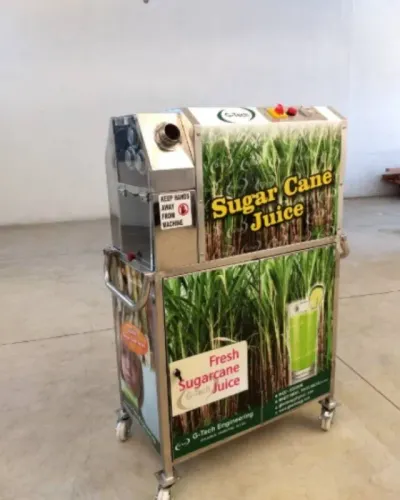
 | Juicer Machine Sugarcane Juicer Machine ( Bin Model -1000) Sugarcane Juicer Machine ( Model : Bin - 1000) It is Very Attractive, Compact and High Effective in Production.It has Inbuilt Dustbin Inside The... View product → |
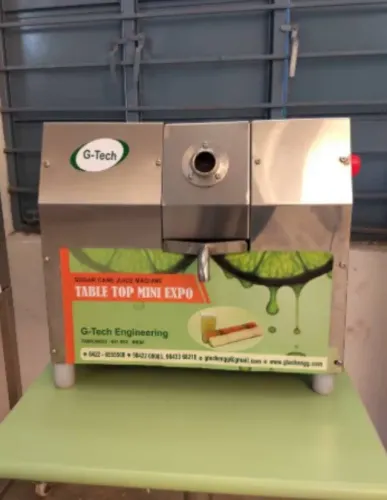
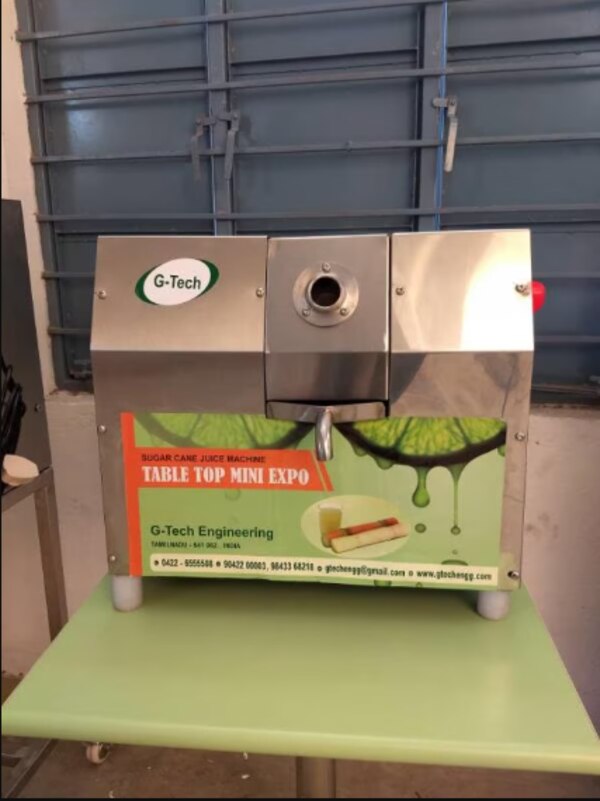
 | G-Tech cane juicer Table Top Mini It is a table top economical model, compact to use. View product → |
Frequently asked questions
What does a sugarcane juicer do that a sugarcane peeler does not?
A sugarcane juicer presses cane through rollers to extract saleable juice and discharge bagasse. A peeler removes the outer material but does not extract juice, so it needs a juicer or another extraction method afterward.
Where does a peeler fit in a juice-shop workflow?
The peeler sits after cane receiving and inspection but before cutting, storage or extraction. After peeling, staff must transfer the cane to a juicer if the shop is selling fresh cane juice.
How should a Coimbatore juice shop size a commercial cane juicer?
Calculate peak-hour glasses, the cane required per glass, feeding time and short cleaning breaks. Select a machine whose practical hourly output exceeds that peak requirement rather than sizing it to the daily average.
Which specifications matter when comparing cane juicers and peelers?
Check roller count and adjustment, food-contact construction, guards, emergency stopping, cleanability, motor rating, electrical phase and voltage, footprint, drainage and service access. A peeler also needs a clear downstream extraction or preparation plan.
Related products
 | G-Tech cane juicer Stand with bin model This machine is very attractive, compact and high effective in production. It has inbuilt dustbin inside the table of the machine. View product → |
 | G-Tech cane juicer Table Top ( Model : TT- 500 Mini ) Table Top 0.5 HP This Machine Is Design For Easy To Carry. In This Machine We Can Get Maximum 60 Litres of Juice/Hr. View product → |
Keywords