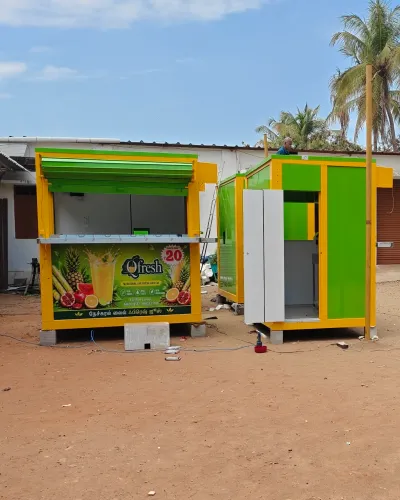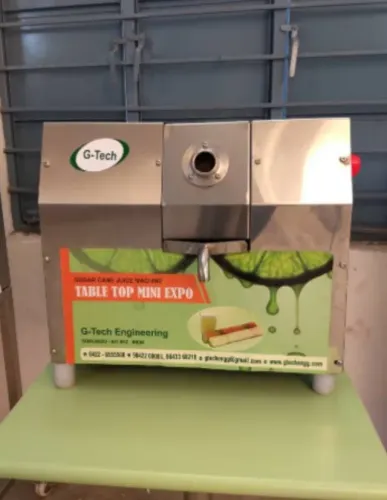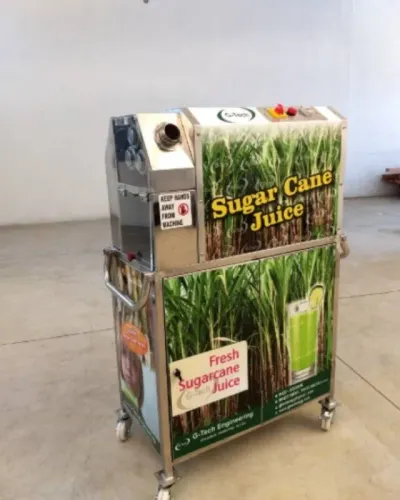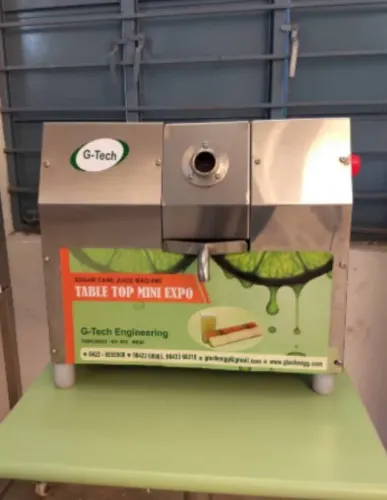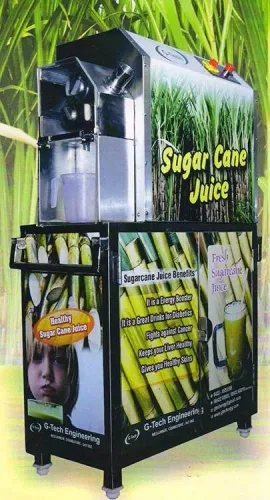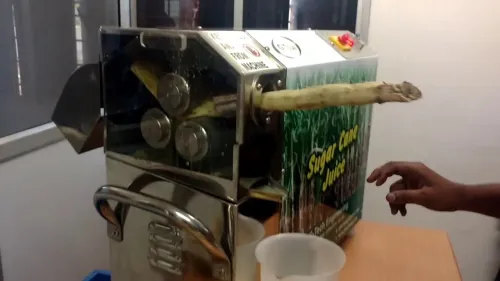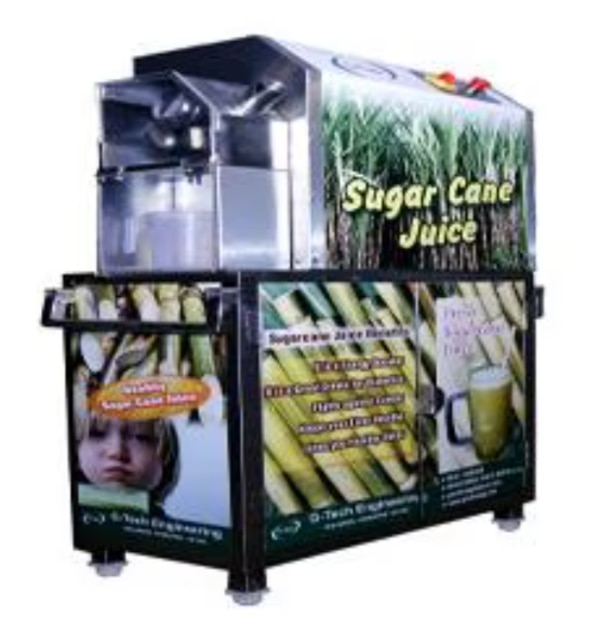
A table-top sugarcane juicer suits a concession only when its real peak-hour output, working clearance, electrical setup and cleaning process match the stall. You will be able to calculate demand, test the machine under your own conditions and decide whether automation improves service or creates new operating risks.
Key takeaways
- Confirm whether rollers pull in cut cane or require manual feeding.
- Compare measured juice output with your busiest 15-minute cup demand.
- Leave space for cane storage, waste collection, cleaning and cup service.
- Test guarding, emergency stops, sanitation and power requirements before buying.
What “Automatic” Actually Removes From the Work
Automatic usually removes repetitive roller-driving and pressing, not the whole preparation job. For automatic table top sugarcane machine concessions, check whether the rollers pull in cut cane or whether you must push each piece into the feed opening.
A sensor or interlock may stop the drive when a guard opens, but do not assume it stops every jam automatically.
| Task | What the machine may do | What you still handle |
|---|---|---|
| Cane feeding | Pull cut cane through powered rollers | Cut, inspect, orient and load cane |
| Juice extraction | Crush cane and direct juice to an outlet | Position the cup, filter pulp and add ice |
| Bagasse handling | Discharge crushed fibre into a chute or tray | Empty the tray and clear blockages safely |
| Stopping | Stop through a switch, guard interlock or overload trip | Press emergency stop and isolate power when needed |
| Cleaning | Provide removable food-contact parts | Remove fibre, wash, sanitize, drain and dry |
A snack concession juice machine still needs a defined end-of-shift routine. Isolate power before reaching near rollers, remove retained fibre, wash and sanitize the rollers, chute and juice path, drain rinse water, and dry the machine. “Automatic cleaning” means little unless the supplier documents its cycle, chemical compatibility and parts covered.
You must also supply clean cane, cups, ice, filters and waste containers. Protect controls, sensors and motors from juice and wash water, and leave enough clearance for your hands to load cane and remove bagasse.
A simple guarded roller machine can be the safer choice when a low-volume stall cannot support automated controls or specialist servicing.
Match Peak Cup Demand to Measured Juice Output
Judge the machine against the busiest 15-minute rush, not average hourly sales. Divide cups sold in that interval by 0.25 to estimate cups per hour, then multiply by cup volume to find required saleable juice output. If arrivals exceed completed cups, the queue grows even while the machine runs.
For an automatic table top sugarcane juicer machine for snack concessions in Coimbatore, obtain the manufacturer’s test basis before trusting a litres-per-hour claim:
- Cane diameter and length used
- Juice yield from that cane
- Number of operators
- Continuous or intermittent duty cycle
A machine tested intermittently on thin cane cannot be compared with one running continuously on thick cane.
Confirm that the complete drive-and-roller rating is continuous and includes overload protection. Ask how to adjust the roller gap and service the gearbox; motor horsepower alone cannot predict queue performance.
Run a timed trial with your actual cane, cups and operator. Record:
- Saleable litres produced
- Electrical current during operation
- Noise during continuous feeding
- Bagasse blockages
- Cleaning time and operator count
Choose the machine only when trial output exceeds calculated peak demand with recovery time between rushes. If the result merely matches demand, one jam, refill or cleaning interruption will lengthen the queue. A headline capacity is useful for comparison, but measured output under your workflow decides whether the machine keeps up.
Plan the Counter Around the Whole Workflow
A published footprint covers the base, not the work zone. Reserve about 600 mm in front of the compact sugarcane juicer for vendors to load cut stalks, place cups, reach controls and remove bagasse; allow 300 mm at the side or rear for guards, drains and cleaning access.
Confirm these allowances against the supplier’s loading and service drawings.
Treat the counter as a structural platform, not a shelf. Obtain the machine’s operating weight, vibration guidance and any point-load requirement, then add the weight of cane, cups, ice, filters and waste containers. A lightweight folding table can shift during feeding or tip when a full waste bin pulls on one edge.
- Mark the published footprint on the counter, then mark the 600 mm loading and serving zone beyond it.
- Keep cane stock on the feed side without forcing the operator to reach across the rollers; cut stalks to the feed opening before service.
- Place cups, ice and a filter within arm’s reach, but keep them outside the splash and bagasse path.
- Leave a clear operator route so hands do not pass around the intake while customers or staff move behind the stall.
- Make room to isolate power, remove retained fibre, wash food-contact parts, drain rinse water and dry the machine.
- Measure the counter’s usable length, depth and height against the machine’s operating dimensions, not its shipping dimensions.
- Ask for the maximum cane-feed rate, duty cycle and waste-bin capacity; a small machine that needs frequent unloading can consume more counter space than its footprint suggests.
Check Power, Guarding, Hygiene and Site Conditions
A table top juicer machine in coimbatore does not become suitable for a concession simply because it fits the counter. Match its nameplate voltage and phase to the site supply, provide a reliable earth connection, and install residual-current protection; voltage variation can stop a motor or damage controls.
Outdoor and semi-outdoor sites need written confirmation about rain, wash-down water, dust and humidity. Treat an unverified enclosure rating as no protection. If the warranty excludes weather exposure, keep the machine under a roof with splash barriers rather than placing it beside an open service counter.
Check the feed opening, roller guards, emergency stop and automatic shut-off before buying. A gap that admits fingers, or a stop control the operator cannot reach while feeding cane, creates an unacceptable rush-hour hazard. Do not bypass an interlock to increase output.
Hygiene depends on the cleaning routine, not the words “food grade.” Juice-contact rollers, strainers, chutes and trays must come apart without special tools, leave no trapped fibre, and dry between shifts. Collect wet bagasse in a covered bin; beneath-counter accumulation causes slips, pests, blocked drains and persistent odour.
Use this site checklist before accepting the machine:
- Confirm supply voltage, phase, earthing, residual-current protection and any claimed enclosure rating.
- Obtain the written weather and wash-down limits, plus warranty terms for temporary or mobile sites.
- Inspect guards, emergency stop, automatic shut-off and access to the feed rollers.
- Request cleaning instructions and verify removable contact parts, drainage and drying space.
- Obtain local support arrangements, stocked rollers, bearings, seals, strainers, switches and belts or couplings, response time, and the warranty procedure. Register the food operation through FSSAI’s FoSCoS system separately from the equipment purchase.
Use a Buyer’s Acceptance Test Before You Commit
A supplier’s headline litres-per-hour figure is not an acceptance test. For automatic table top sugarcane machine concessions, require a trial that uses your cane, cup size, operator count and rush workflow.
1. Run the machine continuously with the cane diameter and length you actually buy. Record saleable litres, cups filled, bagasse blockages, electrical current, noise and cleaning time. Ask whether the quoted output assumes intermittent operation.
2. Request the complete drive-and-roller duty rating, overload protection, roller material, adjustable roller gap and gearbox service procedure. Motor horsepower alone will not show whether the machine can survive your peak queue.
3. Inspect the feed opening and rollers while the machine runs. Reject a design without fixed or interlocked guards, rapid drive stopping and a feed path that keeps hands away from the nip point; a pusher is not guarding.
4. Confirm what “automatic” includes: powered feeding, automatic shut-off, jam recovery and restart controls. Count the operators needed during the timed trial, not the number stated in the brochure.
5. Obtain written support terms covering mobile-site warranty service, response time and stocked rollers, bearings, seals, strainers, switches, belts or couplings. Ask G Tech Engineering the same questions you would ask any supplier.
6. Test the proposed cleaning and juice-handling procedure. Fast extraction does not make sugarcane juice safe to hold at ambient temperature; agree on made-to-order service or validated chilling, heat treatment and holding limits before buying.
Related products
 | G-Tech cane juicer Table Top Mini It is a table top economical model, compact to use. View product → |
 | G-Tech cane juicer Table Top ( Model : TT- 500 Mini ) Table Top 0.5 HP This Machine Is Design For Easy To Carry. In This Machine We Can Get Maximum 60 Litres of Juice/Hr. View product → |
Frequently asked questions
What does automatic operation remove from sugarcane juicing?
It usually removes repetitive roller-driving and pressing. You still need to prepare cane, feed it if required, collect juice, manage waste and clean the machine.
How should you match a juicer to concession demand?
Measure peak cup demand over 15 minutes and compare it with the machine’s measured juice output, allowing time for feeding, pouring and cleaning.
What counter space does a tabletop sugarcane juicer need?
Plan space for the machine, cut-cane staging, cups, juice collection, waste, operator movement and access to clean the rollers and guards.
What should you check before installing the machine at a concession?
Check the electrical supply, earthing, guarding, emergency stop, drainage, cleaning access, food-contact surfaces and the site’s available ventilation and working space.
How can you test a sugarcane juicer before committing to it?
Run representative cane through the machine, measure output and operating time, inspect the juice and waste, test safety controls, and complete a cleaning trial.
Keywords